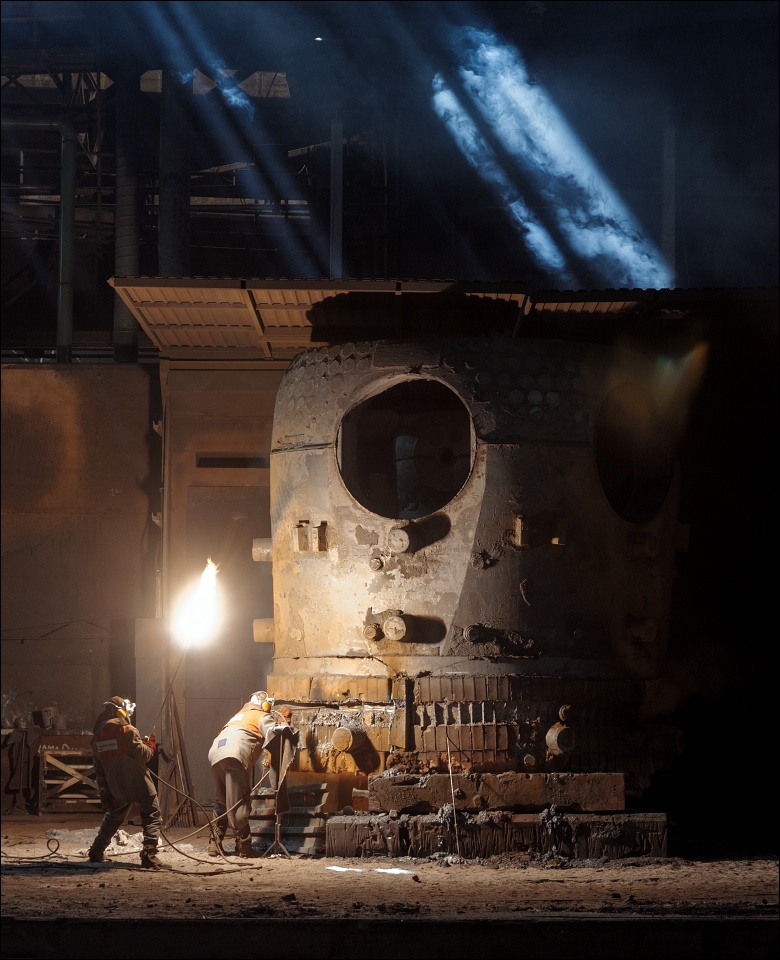
Pilsen Steel, Plzeň
The origins of the famous Czech steelworks date back to 1859, when, during the expansion of Count Arnošt Waldstein’s ironworks in Sedlec, a machining workshop was relocated to the town of Pilsen. In 1866, Emil Škoda, then a relatively unknown engineer, joined the newly established plant as its chief engineer. At that time, production was primarily focused on steam boilers, pumps, blowers and machinery for the sugar industry.
Due to limited production capacity and its dependence on material supplies from the Sedlec ironworks, Škoda initiated the construction of a separate foundry. In 1869, following a lack of interest in further developing the business, Count Waldstein sold the Pilsen plant to him. The development of a major metallurgical base, including iron and non-ferrous foundries, began shortly afterwards.
The steelworks started operating in 1886 with a single 5-tonne Siemens-Martin open-hearth furnace. A second furnace, with a capacity of 10 tonnes, was commissioned just one year later. By 1914, steel production had expanded significantly, with six open-hearth furnaces and three converters in operation.
During the First World War, the Škoda Works became one of the principal weapons suppliers to the Austro-Hungarian army. By 1917, the factory employed up to 30,000 workers. The difficult post-war economic situation was addressed through the integration of the company into the French Schneider & Cie industrial group, based in Le Creusot.
The first two 4-tonne electric arc furnaces were commissioned in 1918. Over the following decades, the steelworks established an international reputation for producing heavy steel castings and supplying the shipbuilding industry.
During the Second World War, the plant was taken over by the German Reichswerke Hermann Göring and became heavily involved in military production. On 25 April 1945, a major US air raid caused extensive damage to the factory complex.
Following the post-war reconstruction, production gradually resumed, focusing primarily on locomotives, heavy machinery and large steel castings.
A major technological milestone was reached in 1981 with the installation of the plant´s first ladle furnace. The final batch of open-hearth steel was melted in 1998, marking the end of an era and the transition towards more modern steelmaking technologies.
In 2003, following the restructuring and separation of the former Škoda engineering operations, the steelworks became known as Pilsen Steel. The company continued its long industrial tradition, specialising in high-quality steelmaking and the production of large, technically demanding forgings and castings.
However, the company´s final chapter was marked by financial difficulties and ownership disputes. Under Russian ownership, Pilsen Steel eventually fell into severe financial distress. The situation deteriorated further as the company struggled with mounting debts, a lack of working capital and an inability to maintain normal production. Following the shutdown of production in 2019, the company entered insolvency proceedings. Despite its remarkable industrial heritage and more than 150 years of steelmaking tradition, the Pilsen steelworks never returned to full-scale operation.
Keywords: pilsen steel, škoda, plzeň, czechia, czech republic, shutdown, ocelarna, steelworks, steel plant, steel industry, beauty of steel, stahlwerk, industrial photography, industriekultur, industrial heritage
Views: 44 ×